
When enterprise learning demands spike, executive leadership often defaults to asking a familiar question: “Do we have the headcount budget to hire another full-time instructional designer?”
Looking solely at baseline salaries creates a significant financial blind spot. In modern Learning and Development operations, evaluating talent costs purely by base pay obscures the true expense of building and maintaining an internal team.
To optimize training budgets, forward-thinking L&D directors look beyond initial hourly rates and calculate the Total Cost of Ownership (TCO) of full-time headcount versus flexible staff augmentation models.
The Total Cost of Ownership (TCO) of a full-time L&D employee includes baseline salary plus 30%–45% in hidden overhead (payroll taxes, health benefits, onboarding, software licenses, and idle downtime between major rollouts). L&D staff augmentation replaces fixed overhead with a variable cost model, eliminating idle-time expense while cutting recruitment and onboarding cycles from months to days.
The Hidden Cost Matrix: Comparing Full-Time Hires vs. Augmented Specialists
A direct comparison reveals where hidden expenses accumulate across the employee lifecycle:
| Cost Component | Full-Time L&D Hire (FTE) | Ingenuiti Augmented Talent |
| Recruitment & Sourcing | $4,000–$7,500 upfront + internal HR time | $0 (Included in delivery) |
| Benefits & Overhead | +25%–35% (Insurance, 401k, taxes) | $0 (Employer of Record handled) |
| Idle Capacity / Downtime | Paid 100% during project lulls | $0 (Scaled down immediately) |
| Authoring Tools & Software | Direct annual company expense per seat | Integrated flexibly / zero seat waste |
| Time-to-Productivity | 30–60 days (Onboarding & ramp-up) | Day 1 deployment |
Calculating the True Expense: The “Idle Time” Trap
Enterprise training needs are inherently cyclical. Major product launches, system implementations, and compliance overhauls demand intense course development for several weeks, followed by periods of routine maintenance.
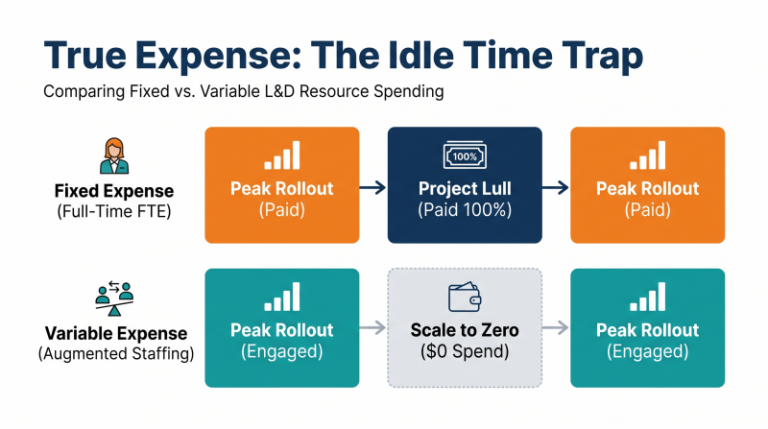
When you hire a full-time Learning Experience Designer (LXD), their salary remains fixed regardless of active output. During project lulls, you continue paying 100% of their base rate, benefits, and hardware overhead.
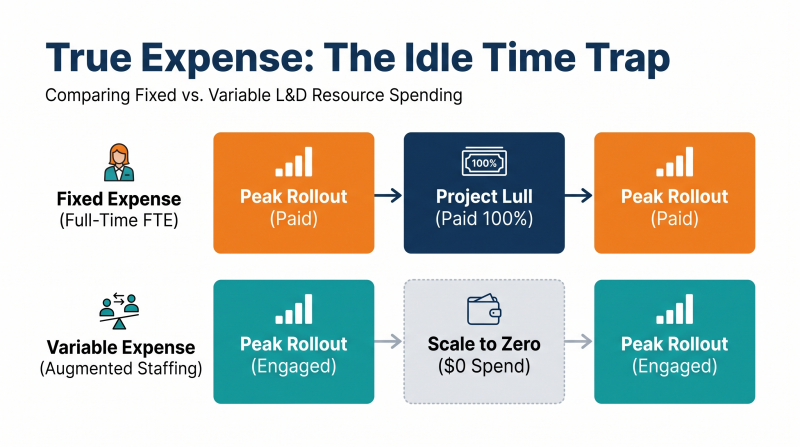
When factoring in an average 20%–30% idle time across a calendar year, the net effective hourly rate of a full-time employee frequently exceeds the rate of a specialized contractor brought in exclusively for high-demand execution windows.
Real-World Applications: Financial Impact in Practice
Examining how these cost structures function during real business scenarios illustrates the strategic advantage of flexible staffing:
1. Navigating Product Launch Bursts in Enterprise SaaS
- The Scenario: A B2B software firm rolls out major platform updates twice a year. During rollouts, course development demand spikes by 300% for 6 weeks, then drops back to baseline maintenance.
- The Traditional Approach: To handle peak volume, the L&D Director hired two permanent Senior Instructional Designers ($120k base + 30% overhead = $312,000 annual fixed commitment). For 7 months of the year, these designers had minimal active deliverables, inflating the department’s cost-per-course built.
- The Augmented Strategy: The company maintained a core strategy team and engaged two augmented LXDs for 8-week bursts twice a year ($48,000 total spend).
- The Financial Result: The business achieved the exact same go-to-market speed while securing over $260,000 in annual budget savings.
2. Bridging Capital Gaps During Hiring Freezes
- The Scenario: A national logistics enterprise experienced a corporate hiring freeze mid-quarter—right as they were scheduled to launch a critical frontline manager safety program across 200 facilities.
- The Traditional Approach: Unable to open full-time requisitions, existing L&D staff absorbed 60-hour workweeks to compensate, leading to severe burnout, delayed rollouts, and the eventual resignation of a core designer.
- The Augmented Strategy: By shifting funding from capital headcount budgets (CapEx) to operational project budgets (OpEx), the enterprise onboarded an augmented Senior L&D Project Manager and LMS Administrator within 48 hours.
- The Financial Result: The safety rollout launched on schedule without violating headcount freezes or incurring costly employee turnover.
Strategic Flexibility: Trial-to-Hire and Risk Mitigation
Beyond direct cost savings, staff augmentation mitigates organizational risk. Bad hires in senior L&D roles cost enterprise companies thousands of dollars in wasted salary, severance, and lost project momentum.
Using an augmented talent model allows L&D leaders to evaluate a contractor’s technical output, speed, and cultural fit on active deliverables before making long-term headcount commitments.
A: Total Cost of Ownership (TCO) evaluates the full financial impact of a team member beyond baseline salary. For full-time L&D employees, TCO includes base pay plus 30%–45% in hidden overhead, such as benefits, payroll taxes, software licenses, and paid idle time between rollouts. Ingenuiti helps enterprise organizations evaluate TCO to transition from high-overhead fixed models to agile, cost-effective talent strategies.
A: Enterprise training demands are naturally cyclical. During quiet periods between major launches, a full-time employee’s salary and benefits remain 100% fixed regardless of active output. Partnering with Ingenuiti eliminates the 20%–30% annual expense of idle time by bringing in specialized talent exclusively during high-demand execution windows.
A: Unlike traditional outsourcing or agency models, Ingenuiti integrates pre-vetted L&D talent directly into your internal workflows. You maintain complete creative control over deliverables while Ingenuiti handles Employer of Record responsibilities, eliminating recruitment fees, overhead, and long-term headcount liabilities.
A: Yes. Ingenuiti enables L&D leaders to fund critical talent using operational project budgets (OpEx) rather than capital headcount budgets (CapEx). This strategy allows enterprise teams to meet urgent training deadlines and prevent internal burnout without violating headcount restrictions.
Ready to Optimize Your L&D Budget?
Stop overpaying for idle time and hidden headcount overhead. Partner with Ingenuiti to access pre-vetted instructional designers, LXDs, and LMS administrators ready to deploy on Day 1.