

When enterprise learning initiatives face sudden skill gaps or aggressive deadlines, traditional recruitment cycles threaten project delivery. L&D leaders are constantly forced to evaluate how to structure their teams for maximum velocity, quality, and cost efficiency.
Understanding the operational trade-offs between L&D Staff Augmentation, Project Outsourcing, and Full-Time Direct Hiring is critical to building an agile learning organization.
L&D Staff Augmentation inserts pre-vetted learning and development specialists directly into an existing team to fill immediate capacity or skill gaps while maintaining internal project control. Outsourcing transfers full project management and execution to an external vendor. Direct Hiring adds permanent headcount, which offers long-term continuity but requires high overhead and 60+ day recruitment cycles.
Comparative Breakdown: Evaluating Your Options
Selecting the wrong engagement model leads to budget overruns or lost project control. The table below outlines how each approach performs across critical operational metrics:
| Metric / Dimension | L&D Staff Augmentation | Project Outsourcing | Full-Time Direct Hire |
| Time to Deploy | 24–48 Hours to talent placement | Dependent on project size, but 4–12 Weeks | 60–90 Days |
| Day-to-Day Control | Full internal oversight | Managed by vendor | Full internal oversight |
| Best For | Fluctuating workloads & skill gaps | Turnkey end-to-end builds | Permanent core capabilities |
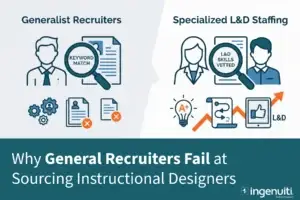
| Recruitment Risk | Minimal (pre-vetted talent) | Shifted to vendor | High (cost of bad hire) |
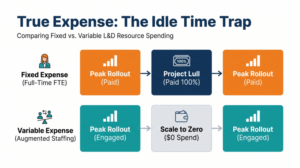
| Cost Flexibility | High (scale up/down on demand) | High fixed project cost | Low (fixed overhead/benefits) |
When to Choose L&D Staff Augmentation
Staff augmentation is ideal when you have internal project management in place but lack specific execution capacity or niche skills. Rather than handing over control of your curriculum, you bring targeted talent—such as Articulate Storyline developers, Learning Experience Designers (LXDs), or LMS Administrators—directly into your existing workflows without onboarding friction.
Real-World Applications: Staff Augmentation in Action
1. Managing Capacity Spikes During Platform Rollouts
- The Scenario: A global logistics provider was deploying a new enterprise ERP system. The internal L&D team had capable instructional designers, but the sheer volume of training modules required for 12,000 frontline workers overwhelmed their 3-person team.
- The Solution: Instead of outsourcing the entire project at a massive fixed cost, the L&D Director used staff augmentation to bring in three senior instructional designers for a 90-day sprint.
- The Result: The augmented designers plugged directly into the internal team’s templates and sprint cycles within 48 hours, keeping the platform launch on schedule without adding permanent overhead.
2. Filling Hyper-Specialized Skill Gaps
- The Scenario: An enterprise technology firm needed to create immersive, 3D video animations and scenario-based branching logic for their customer-facing academy. Their internal team excelled at standard instructor-led training (ILT) design, but lacked advanced media development capabilities.
- The Solution: Rather than spending months attempting to hire a full-time multimedia developer, they augmented their team with a specialized L&D video animator.
- The Result: The specialist delivered high-end custom assets in three weeks, upskilling the internal team on template maintenance before offboarding seamlessly.
When Outsourcing or Direct Hiring Makes Sense
While staff augmentation offers maximum agility, other models suit different strategic goals:
- Project Outsourcing: Best when internal bandwidth is zero and complete end-to-end design, development, and project management are required. Shifting the full burden of a project to an external vendor can enable teams to tackle numerous critical initiatives at the same time.
- Direct Hiring: Best for foundational, permanent L&D leadership roles—such as a VP of Learning or Head of Talent Development—where deep institutional knowledge retention and culture-building outweigh flexibility.
FAQs: Choosing the Right L&D Engagement Model
The primary difference is control and management. With L&D staff augmentation, you retain full day-to-day project management and integrate external specialists directly into your existing team workflows. With project outsourcing, you hand over full project management, execution, and delivery ownership to an external vendor for a turnkey result.
For project-based, seasonal, or specialized needs, yes. While staff augmentation carries a higher hourly rate than base employee salary, it eliminates long-term costs like employee benefits, payroll taxes, onboarding friction, and severance. It allows enterprise L&D teams to convert fixed labor overhead into a flexible variable cost.
Drawing from a global network of over 30,000 screened learning professionals, Ingenuiti typically locates and presents pre-vetted quality talent—such as Instructional Designers, LXDs, or LMS Administrators—within 24 to 48 hours. This allows enterprise teams to place the right expert on their project within the week, avoiding the typical 60 to 90 days required for full-time direct hiring.
Ready to Scale Your L&D Team in 24–48 Hours?
Don’t let talent shortages or aggressive deadlines delay your critical learning initiatives. Whether you need a single specialized developer or a team of senior instructional designers, Ingenuiti connects you with pre-vetted L&D experts ready to plug directly into your workflow.
Get Matched With L&D Talent Today
Looking for end-to-end custom content or global translation support? Explore our full suite of global learning services.